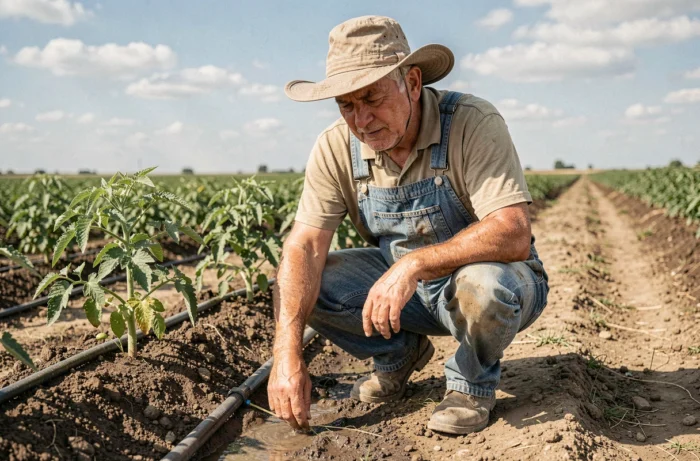
Watering crops during the day triggers the same reactions every summer. Irrigation cannons operate under a blazing sun, and passersby see it as a massive waste. Scientific data and recent pricing developments tell a different story, which this article examines point by point.
Evaporation Losses During Daytime Irrigation: Actual Measurements
The gap between public perception and measured reality is the starting point for any analysis on this subject. Jean-Louis Durand, research director at Inra and bioclimatologist, has quantified the phenomenon in Vienne.
| Parameter | Daytime Irrigation | Common Belief |
|---|---|---|
| Share of water benefiting the plant | 97 % | Much lower |
| Share evaporated before reaching the soil or foliage | 2 to 3 % | Assumed to be very high |
| Main location of loss | At the exit of the water cannon (suspended jet) | On the ground or leaves |
These figures show that almost all the water projected actually reaches the crop. The loss occurs in the droplets suspended between the nozzle and the ground, not on the foliage exposed to the sun.
Water that touches the leaves or warm soil does not evaporate massively because it quickly penetrates the vegetation cover or the soil. The physics of evaporation at the soil-plant interface differs from that of a puddle on asphalt, which explains the reason why farmers water in full sunlight without fearing water loss.
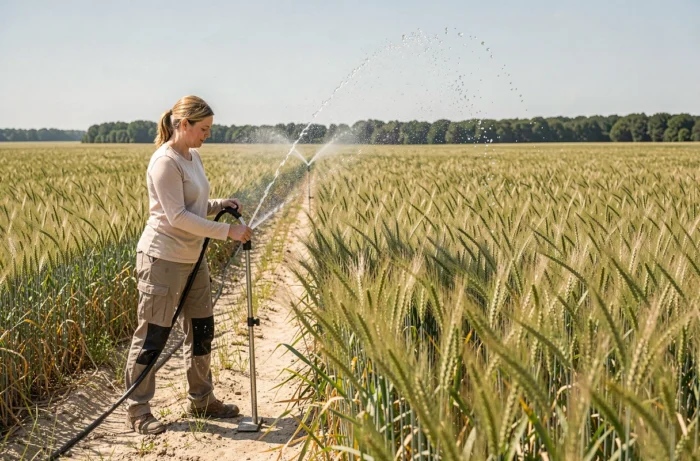
Electric Pricing and Nighttime Irrigation: A Disappearing Advantage
For a long time, irrigating at night had a clear economic advantage. Agricultural professional contracts distinguished between peak and off-peak hours, making nighttime pumping cheaper. This logic has weakened.
An Alsatian farmer quoted by L’Alsace in August 2026 explains that electricity is charged at the same price at night and during the day because solar photovoltaic overproduction has leveled prices on certain contracts. When the cost of a kilowatt-hour no longer varies by time, the incentive to shift irrigation to nighttime disappears.
This phenomenon particularly affects areas heavily equipped with solar panels. Massive photovoltaic production during the day has altered the structure of wholesale prices, and this change is gradually reflected in agricultural professional contracts.
What This Pricing Change Means for Operators
- Daytime pumping no longer costs more than nighttime pumping on the affected contracts, removing the time constraint
- Farmers can irrigate when the plant needs it most, that is, when water stress is at its peak, in the heat of the day
- Work time management improves: monitoring irrigation at 2 PM is simpler than at 3 AM
However, this situation does not apply to all regions. Operators whose contracts maintain a significant price gap logically continue to prefer nighttime irrigation.
Drought Orders and Localized Irrigation: An Evolving Regulatory Framework
Summer water restrictions have tightened in recent years. Prefectural orders limit or prohibit sprinkler irrigation (cannons, ramps) during the hottest hours in many departments. Irrigation bans have been reported in several dozen French departments during recent drought episodes.
In contrast, the drought orders for 2025-2026 tend to exempt localized irrigation (drip, micro-sprinkling) from time restrictions. This differentiated treatment encourages some operators to invest in these systems, which can operate during the day even in periods of heightened vigilance.
Traditional Sprinkling vs. Localized Irrigation During Restrictions
Sprinkling with a cannon projects large volumes of water into the air, making it visible and politically sensitive. Drip irrigation delivers water directly at the base of the plant, with evaporation losses even lower than those measured by Inra for sprinkling.
A farmer equipped with drip irrigation can therefore irrigate in the middle of the afternoon without violating the current prefectural order, while their neighbor using a cannon must wait until night. This regulatory discrepancy partly explains why we see more daytime irrigation: localized systems, allowed during the day, are multiplying.
Water Stress and Corn Flowering: Irrigating When the Plant Demands It
Corn, the most irrigated summer crop in France, goes through its flowering phase in the heart of summer. A water deficit at this stage jeopardizes the entire harvest. Waiting until night to irrigate means leaving the plant under water stress during critical hours, when transpiration is at its peak and water demand reaches its maximum.
The plant does not pause its physiology at noon. Photosynthesis is in full swing, stomata are open, and every hour without available water at the root level reduces the final yield. Irrigating at 2 PM is not a logistical whim; it is a response to the biological calendar of the crop.
Recent extreme temperatures further complicate matters. Beyond certain thermal thresholds, irrigation is no longer sufficient to protect crops, as highlighted by analyses published in Environnement Santé Politique in August 2026. Water supplied during the day remains useful, but it does not indefinitely compensate for heat that exceeds the plant’s physiological tolerance.
Watering in full sunlight thus relies on a convergence of factors: marginal evaporation losses measured by Inra, an electricity pricing structure that no longer favors nighttime, drought orders that allow localized irrigation during the day, and a physiological need of crops that does not wait for sunset. The public debate would benefit from integrating this data rather than judging irrigation solely on its visual appearance.