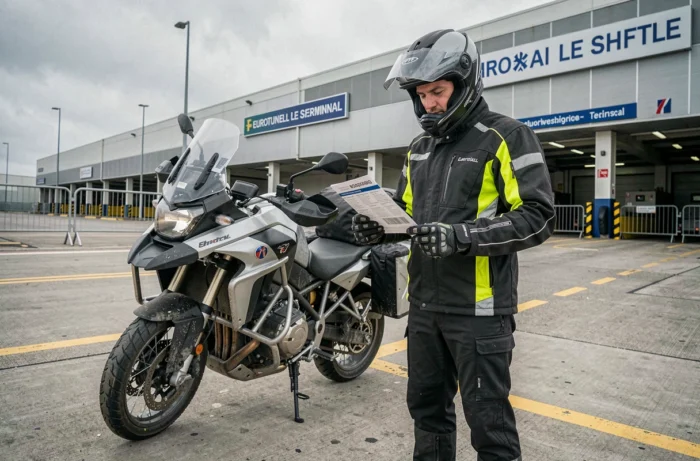
The Channel Tunnel by motorcycle relies on the LeShuttle service, which loads two-wheelers into closed carriages between Calais and Folkestone. The crossing takes about 35 minutes of pure rail, engine off, motorcycle on its stand. No straps, no ground fixation. The motorcycle fare is around half the price of a car passage, including driver and passenger.
UK ETA and border checks
Since the introduction of the Electronic Travel Authorisation (ETA) for the UK, every motorcyclist must check if they are affected before booking. The ETA is linked to the passport: a passport change requires a new application. It is not a visa and does not guarantee entry at the border.
Do not confuse the UK ETA with the European EES (Entry/Exit System), which concerns non-European travelers on short stays in the Schengen area. These are two distinct systems. The implementation of the EES may affect waiting times at the adjacent borders in Calais, where French and British checks occur at the same site.
In practice, allow extra time at the terminal beyond the usual 90 minutes recommended, especially during the summer period. Check Eurotunnel and authority guidelines before each crossing, as procedures evolve. You can also learn more on Clic Auto to find detailed conditions for motorcycle passage.
Mandatory equipment on the French and British sides
French equipment rules apply throughout the journey to the Calais terminal, including within the site. A certified helmet and CE-certified gloves are mandatory for both the rider and passenger. A high-visibility vest must be on board and worn in case of an emergency stop.
A commonly misunderstood point: an ECE 22.05 helmet already in circulation remains legal. The sales obligation pertains to the ECE 22.06 standard, but it does not require the replacement of a helmet compliant with the old standard as long as it is not damaged or expired.
Regulatory differences in the UK
On the British side, gloves are not mandatory. A helmet is required, but the accepted standard differs: helmets compliant with British regulation (BS 6658:1985) or the ECE standard are both valid. However, driving is on the left as soon as you exit the Folkestone terminal. Adjust your headlight settings to avoid dazzling oncoming vehicles.
- Sticker or asymmetrical headlight deflector to correct the beam (mandatory on non-adjustable optics)
- Mirrors: ensure that the field of vision covers the left side, which becomes the traffic side
- License plate: a sticker F or the European marking is sufficient to identify the country of origin
Actual motorcycle boarding process at the Calais terminal
Motorcycles do not follow the same route as cars at the terminal. After passport control and passing through the kiosks, two-wheelers are grouped in a dedicated lane. Boarding usually occurs first, before light vehicles.
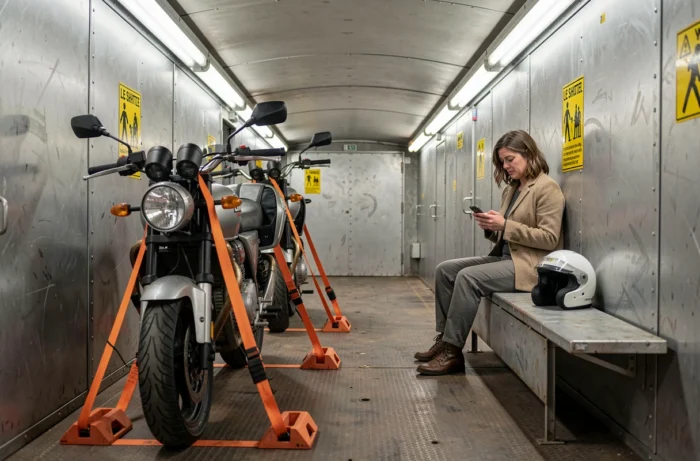
Once in the carriage, you turn off the engine and leave the motorcycle on its side stand. No strap is necessary: the carriage is closed, the speed is constant, and lateral accelerations are almost nonexistent during the journey. You remain standing or sitting close to your machine.
Luggage and top case in the carriage
Everything fixed to the motorcycle (side cases, top case, tank bag) stays in place. No specific volume restrictions are mentioned for motorcycle luggage, but the overall size of the two-wheeler must allow entry into the carriage. Motorcycle trailers are not accepted on the LeShuttle motorcycle service: only the motorized two-wheeler is allowed.
LeShuttle motorcycle fare and ticket flexibility
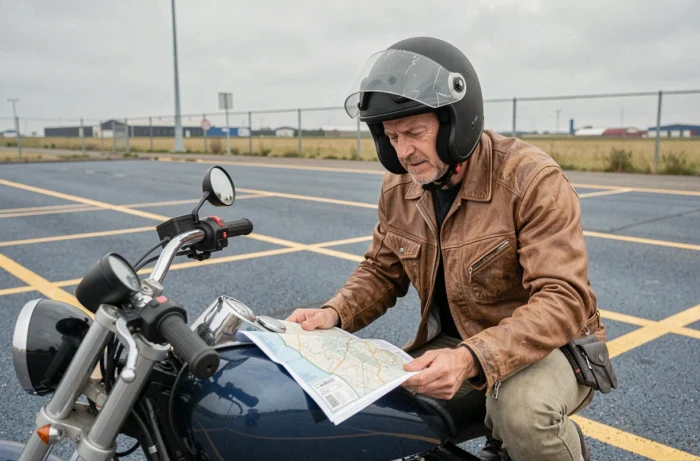
The motorcycle fare for a one-way crossing is around thirty euros, or about half the fare charged for cars. The driver and any potential passenger are included in the price. The fare variation depends on the date, time, and booking lead time.
Three types of tickets coexist, with different levels of flexibility. The cheapest ticket imposes a fixed schedule with no modifications allowed. Flexible tickets allow changing trains on the same day, subject to availability. Before paying, check these three points:
- Cancellation and refund conditions (some tickets are non-refundable)
- Possibility of changing the schedule without extra charge
- Coverage of your motorcycle insurance abroad, including vehicle repatriation assistance in case of breakdown across the Channel
Tunnel or ferry for a motorcycle: the deciding factor
The Calais-Dover ferry takes about 90 minutes and exposes the motorcycle to spray, wind, and rolling movements on the vehicle deck. The tunnel eliminates these constraints. For a motorcyclist transporting electronic equipment or luggage sensitive to moisture, the tunnel is the safest choice for the equipment. The ferry still has an advantage for those who want to eat or rest during the crossing.
The overall cost differs little between the two options on a one-way trip. The gap widens on round trips during high season, where the tunnel sometimes offers more competitive group rates for motorcycles. Always compare both before booking, including the total door-to-door time and not just the crossing time.