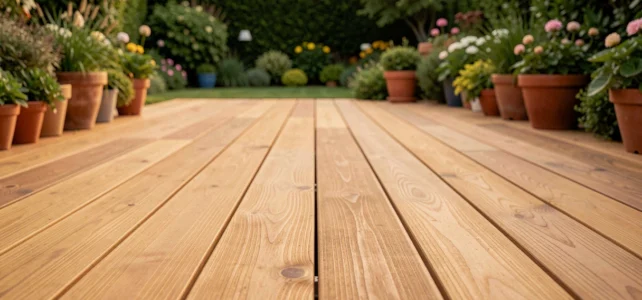
A terrace laid at ground level, poorly ventilated, with regular water splashes from a gutter or a pool: this is the scenario that ruins most wooden floors in just a few seasons. The choice of wood for a durable terrace does not start with aesthetics, but with an analysis of the actual constraints of the site. Species, usage class, load-bearing structure: each parameter directly influences the longevity of the project.
Usage class of the boards and structure: two distinct logics
We often hear about “class 4” as a universal key. The reality is more nuanced. The NF EN 335 standard distinguishes woods based on their resistance to moisture, and the load-bearing structure has different requirements than the visible boards.
The joists and beams, confined near the ground, remain damp for a long time. They require class 4 wood, capable of withstanding prolonged contact with water without rotting. The terrace boards, on the other hand, dry out between rain episodes: class 3 is sufficient in most well-ventilated above-ground configurations.
When trying to find out which wood to choose for a terrace, this distinction changes the entire budget. Installing class 3 softwood boards on a frame made of class 4 oak or pressure-treated pine allows for a combination of economy and durability, rather than over-dimensioning everything.
For a terrace around a pool or laid directly on pedestals at ground level, the opposite logic applies: minimum class 4 boards and structure, as water splashes and lack of ventilation create a permanently hostile environment.
Thermo-treated wood: the alternative gaining ground against exotics
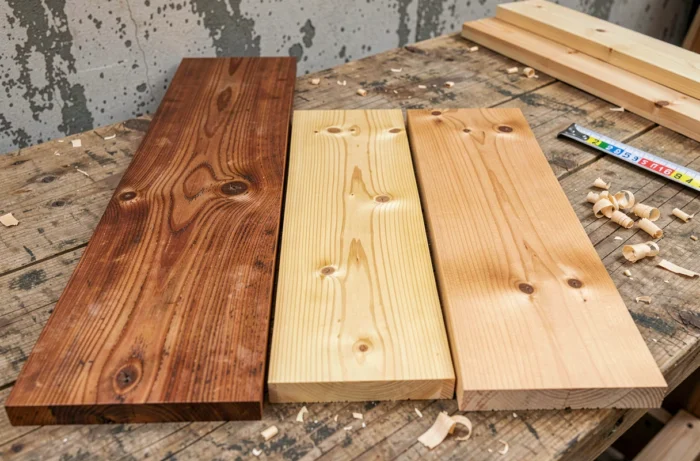
Thermo-heated ash, thermo-treated pine, or modified poplar occupy a niche that competitors rarely explore in depth. The principle: heating the wood to high temperatures (without chemicals) to modify its cellular structure. The result is better dimensional stability and increased resistance to moisture.
On the ground, it is observed that these woods gray uniformly, without the irregular stains sometimes seen on pressure-treated softwoods. Their surface hardness remains lower than that of ipe, but they are well-suited for terraces with moderate family use.
Thermo-treatment positions these woods between class 3 and class 4, depending on the starting species and heating protocol. Feedback varies on this point, as not all manufacturers apply the same temperatures or durations. Before purchasing, it is important to check that the supplier clearly indicates the usage class obtained after treatment.
Exotic species and European woods: concrete selection criteria
Ipé, cumaru, and padouk dominate the exotic wood segment for terraces. Their high density gives them natural resistance to wood-destroying insects and wood-decaying fungi, without chemical treatment. Aesthetically, the shades range from deep brown to reddish, with pronounced grain.
What you don’t see during installation
A dense exotic wood is also heavy and difficult to machine. Drilling the boards requires systematic pre-drilling, stainless steel screws are mandatory (regular steel reacts to tannins), and cuts take longer than with pine. On a job site with difficult access, these constraints significantly increase installation time.
Pressure-treated Scots pine remains the most economical choice for a functional terrace. Treated to class 4, it withstands common outdoor conditions. Its lifespan is shorter than that of exotic wood, but its cost per square meter is significantly lower.
European oak, naturally class 4, offers an interesting compromise between durability and short supply chain. Its price is between treated pine and exotics. It is favored when aiming to limit the carbon footprint of the project without sacrificing longevity.
- Ipé or cumaru: high natural durability, warm tones, oil maintenance to preserve color, high budget and technical installation.
- Pressure-treated class 4 pine: unbeatable quality-price ratio, quick graying without saturator, suitable for large areas on a tight budget.
- European oak: natural durability class 4, short supply chain, good aging, intermediate price.
- Ash or thermo-treated pine: improved dimensional stability, uniform graying, check the actual usage class with the supplier.
Maintenance of terrace wood: what really matters over time
All species gray over time due to UV exposure. This graying does not alter the mechanical resistance of the wood. If the silver patina suits you, maintenance is limited to an annual cleaning with water and black soap, using a stiff brush.
To preserve the original shade, a saturator applied once or twice a year protects the color without forming a film. Unlike a varnish or film-forming stain, the saturator penetrates the fibers and does not peel. It should be applied to clean, dry wood, ideally in spring.
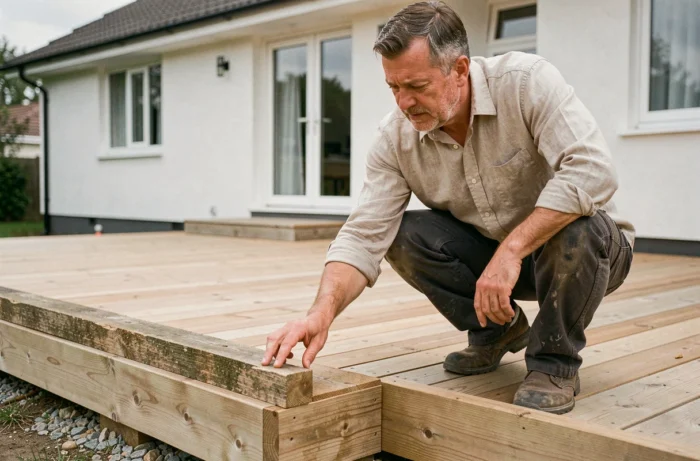
A often overlooked point: ventilation under the boards. Insufficient space between the ground and the substructure traps moisture and accelerates degradation, regardless of the wood chosen. An air gap of at least a few centimeters and adjustable pedestals are recommended rather than direct installation on a slab.
- Annual cleaning with black soap to remove moss and dirt.
- Saturator once or twice a year if you want to preserve the natural color.
- Check the fasteners (stainless steel screws) and replace split boards before they retain water.
Technical bamboo and composite: should we still talk about “wood”?
High-density bamboo (Thermo-Density type) is now positioned as a full-fledged terrace material, with durability comparable to very dense woods. Its rapid growth makes it an environmentally coherent choice, but its availability in France remains more limited than that of classic species.
The composite (a mix of wood fibers and polymers) eliminates the question of regular maintenance. It does not gray, does not split, but gets hotter in full sun than solid wood. On a terrace exposed to full sun without shading, the surface temperature in summer can make walking barefoot uncomfortable.
Neither technical bamboo nor composite is wood in the strict sense. Their interest is measured against what one is willing to sacrifice: the natural feel and living patina of solid wood, against almost zero maintenance.
The final choice depends on three parameters that can be prioritized in this order: the actual exposure of the site (moisture, ventilation, proximity to water), the overall budget including installation and maintenance over ten years, and only then the desired aesthetics. A well-installed and properly ventilated pressure-treated pine will last longer than an ipe screwed onto undersized joists.