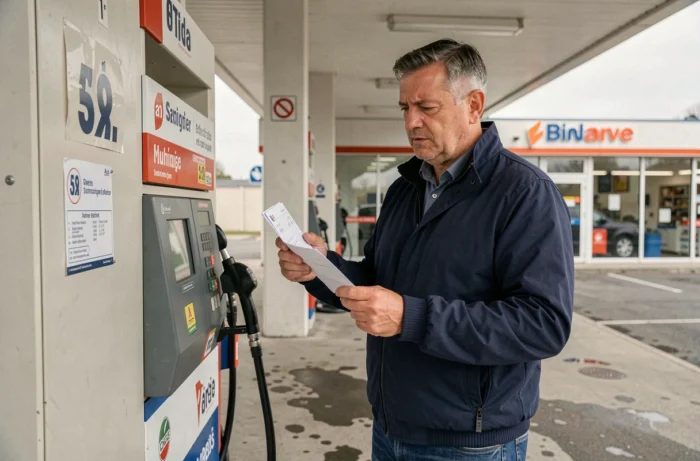
The bank check remains a legal means of payment in France, but its presence at gas stations has significantly decreased. Most service stations today operate on a 24/7 automated basis, without a physical cashier, which mechanically excludes checks. Finding a fuel distribution point where this payment method is still accepted requires understanding some legal rules and targeting the right networks.
Legal obligation and refusal of checks at service stations
A merchant in France is only required to accept one means of payment: cash, up to a limit of 1,000 euros for a customer tax-resident in the territory. Checks, on the other hand, are considered optional means of payment. A service station can therefore refuse them without breaking the law, provided that this restriction is clearly displayed.
There is a notable exception. Stations affiliated with a certified management center (CGA) are required to accept either checks or credit cards. When they choose to accept checks, they must indicate this with a visible sign at the entrance or at the cashier. This legal detail explains why some large retail chains, often members of a CGA, maintain this option.
Identifying a service station that accepts checks thus involves locating sales points with a cashier operated by a human and, ideally, affiliated with a certified management center.
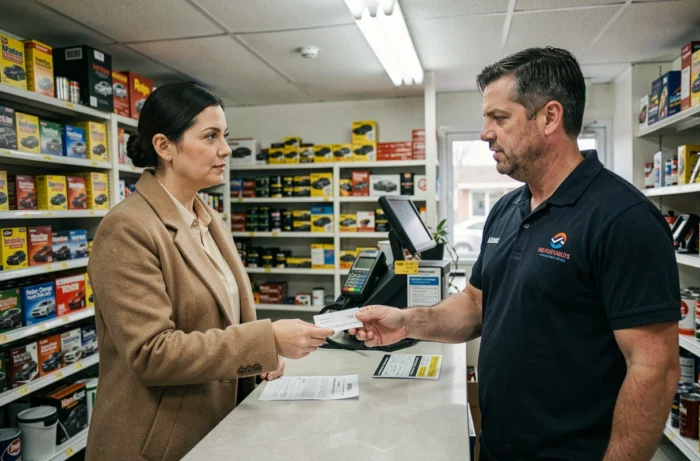
Large retail chains: the main network for paying by check
Stations attached to a supermarket or hypermarket are the most reliable source. Their operation relies on a cashier integrated into the store or a dedicated counter for the station, making the processing of a check technically possible.
E.Leclerc, Intermarché, and Système U
The E.Leclerc network generally accepts checks at its stations equipped with a cashier. Intermarché and Système U apply a similar policy, although each sales point sets its own conditions (minimum amount, presentation of an ID, payment limit).
Before heading out, a phone call remains the safest method. Policies vary from store to store and can change without notice, especially when the station switches to automated mode in the evening or on weekends.
Carrefour and other chains
Carrefour also offers payment by check at some of its stations with cashiers. The rule is the same: the presence of a human operator conditions acceptance. The automatic stations of these chains, recognizable by the absence of a welcome building, only accept credit cards.
Highway stations and independents: rarer cases
Stations located in highway rest areas almost all have a shop with a cashier. Some accept checks, but this practice is tending to disappear. Networks like TotalEnergies favor credit cards, loyalty cards, and mobile apps as primary means of payment.
For independent stations, the situation is heterogeneous. An independent manager can certainly accept checks if they wish. These stations are often found in rural areas, where the clientele is loyal and the risk of non-payment is perceived as lower.
- Stations with a physical cashier (large retail, highway rest areas, independents) are the only ones that can technically process a check.
- 24/7 automats only accept credit cards, sometimes with a pre-authorization that temporarily blocks an amount on the account.
- Stations affiliated with a CGA that have chosen checks as an alternative means are required to accept and display them.
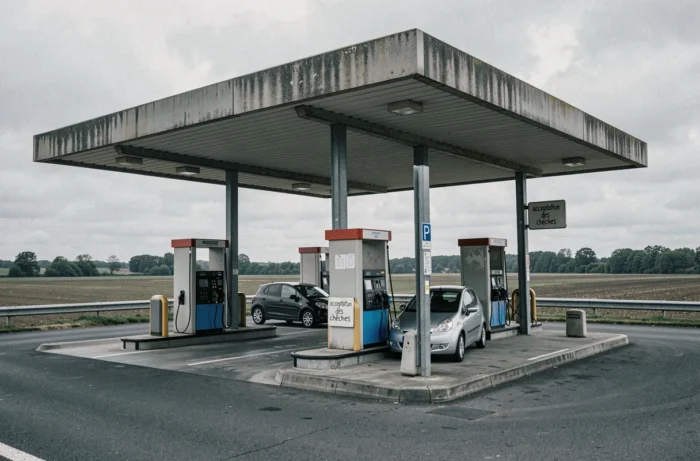
Practical conditions for paying by check at the pump
Filling out a check at a service station is not done exactly like at a regular merchant. Several constraints are added, related to the risk of non-payment and the nature of the product sold.
Required documents and verifications
The majority of stations that accept checks require a valid ID. Some also require that the check be made out to the name of the chain, with the vehicle registration number written on the back. These precautions allow the manager to protect themselves against checks without sufficient funds.
A minimum amount may be imposed. The cashier may also consult a verification file (such as Vérifiance) to ensure that the check is not subject to opposition.
Special case: ANCV holiday vouchers
The holiday vouchers issued by ANCV are a special case. They are not regular bank checks, but payment titles accepted by approved professionals. Some service stations, particularly in tourist areas, accept them for fuel. The list of acceptance points can be consulted on the ANCV website.
Why checks are disappearing from service stations
The underlying trend is clear. The General Directorate of Public Finances has initiated a gradual elimination of check payments in the public sector by 2028. This dynamic is reflected in private usage: consumers are using checks less and less, and merchants are losing the habit of processing them.
For station managers, checks accumulate several disadvantages: processing time, risk of non-payment, and time spent at the cashier. In contrast, contactless payment takes just a few seconds, and the credit arrives in the merchant’s account within one to two business days.
Motorists who still rely on checks should anticipate. Verifying by phone the acceptance of checks before heading out remains the most reliable reflex, as no centralized and comprehensive directory lists compatible stations in real-time. Large retail chains with cashiers remain the first reflex to have, and the trend will not reverse in the coming years.