
Two-thirds of the French say they have experienced at least one moment of discomfort or stress related to the state of their housing in the past twelve months, according to a CSA Research study for La Compagnie des Lavandières published in August 2026. This gap between the daily effort made and the comfort actually perceived raises a measurable question: which levers produce a tangible effect on the organization and well-being in a home, and which remain cosmetic?
Thermal comfort: the combined effect of insulation, ventilation, and solar protection
The Somfy-Verian study on the adaptation of the residential stock to climate change, published in August 2026, provides a rarely highlighted numerical benchmark. Combining insulation, nighttime air circulation, and solar protections reduces thermal discomfort by 87%. When applied separately, these same actions produce significantly more modest decreases.
This result changes the hierarchy of priorities. Installing roller shutters without revising insulation, or insulating the attic without planning for nighttime ventilation, only provides a fraction of the potential gain. The thermal comfort of a home depends on the complementarity between these three aspects, not on any one of them taken in isolation.
| Strategy | Effect on thermal discomfort |
|---|---|
| One lever only (insulation or ventilation or solar protection) | Modest decrease |
| Two combined levers | Intermediate decrease |
| Three combined levers (insulation + air circulation + solar protections) | Reduction of 87% |
For homeowners looking for practical home advice, this table summarizes the trade-off: a partial investment generates partial comfort, and the difference between two and three levers remains significant.
DPE obligations and housing organization: the timeline that forces choices
The comfort of a home is not limited to interior layout. The Climate and Resilience Law imposes a timeline for energy renovation that permanently modifies the equipment of homes.
- Since January 1, 2025, homes classified G+ on the DPE (more than 450 kWh/m²/year) are prohibited from being rented.
- From January 1, 2028, this prohibition will extend to all homes classified F.
- From January 1, 2034, homes classified E will be affected in turn.
These deadlines do not only affect landlords. An owner-occupier considering selling in the coming years has an interest in anticipating. A home classified F or G loses attractiveness in the market well before the regulatory deadline.
On the other hand, energy renovation work (insulation of walls, replacement of windows, installation of an efficient VMC) simultaneously improves thermal comfort, indoor air quality, and space organization. Replacing an old convector with a more compact heating system frees up usable space, which directly relates to the issue of storage.
Storage and furniture: what works by room
Competitors are multiplying generic tip lists. The problem is that most of this advice ignores a simple constraint: each room has a different floor area / storage volume ratio. An effective solution in a 12 m² kitchen becomes absurd in a 3 m² entrance.
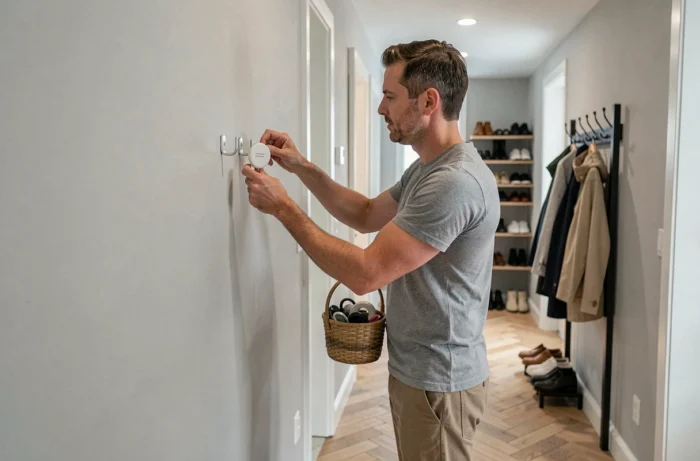
Entrance and hallway: vertical volume
In narrow spaces, horizontal storage quickly saturates the passage. High shelves and wall hooks exploit height without reducing circulation. A closed shoe cabinet, even if shallow, eliminates the visual clutter that immediately gives an impression of a cramped home.
Office and workspace: closed drawers versus open shelves
An office cluttered with visible files generates a measurable cognitive load. Closed drawers hide functional clutter, while open shelves are suitable for decorative items or frequently consulted books. Separating active storage (drawers) and passive storage (shelves) reduces daily search time.
Bedroom: under the bed, an underutilized space
The space under the bed often represents several dozen liters of unused storage. Flat rolling bins can hold seasonal linens or spare duvets. This invisible storage frees up the wardrobe for everyday clothes, streamlining the morning routine.
Lighting and perception of space: an underestimated lever
Lighting alters the perception of a room’s volume without moving a single piece of furniture. A single central light (ceiling fixture) visually flattens the space. Multiplying light sources (reading lamp, LED strip under a piece of furniture, wall sconce) creates distinct zones within the same room.
Three light points at different heights are enough to visually structure a living room. The ceiling fixture provides ambient light, a low lamp delineates the reading corner, and indirect lighting behind a piece of furniture enlarges the perceived room.
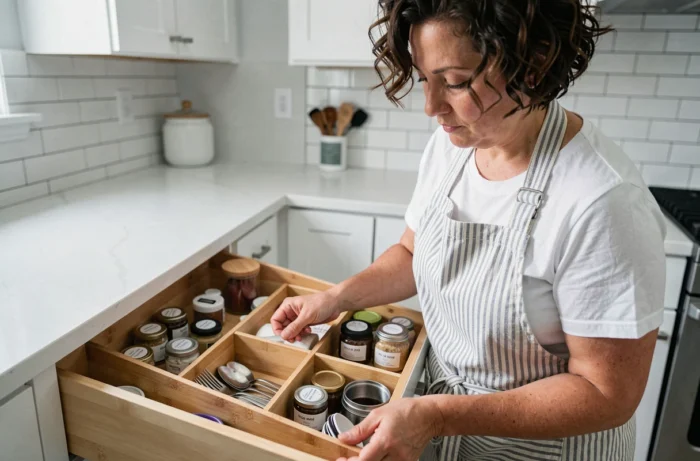
This principle also applies to technical rooms. In a kitchen, lighting under high cabinets improves work comfort on the countertop while making storage spaces more visually accessible.
Indoor air quality: VMC maintenance often neglected
A VMC whose vents are not regularly cleaned loses airflow and allows humidity to accumulate. Excessive humidity promotes mold, degrades wooden furniture, and reduces respiratory comfort. Cleaning the extraction vents and air inlets is a simple operation that maintains air quality without professional intervention.
This regular maintenance logically complements the insulation and ventilation work mentioned above. A well-insulated but poorly ventilated home concentrates indoor pollutants, which cancels out part of the comfort gain.
The comfort of a home rarely hinges on a single front. Available data shows that the most significant gains come from the combination of several levers, whether thermal, adapted storage by room, or air quality. 66% of the French feel stress related to their housing: there remains ample room for improvement, provided that action is taken on the right aspects simultaneously.