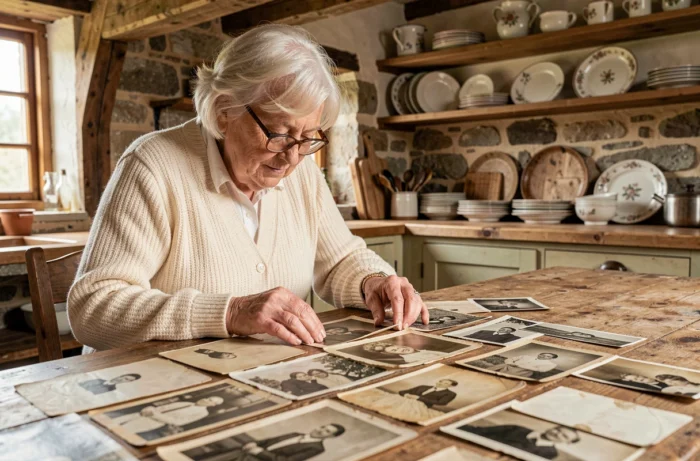
A cardboard box found at the back of a closet, yellowed prints slipped between the pages of an account book: this is often how the search for old photos of a family home begins. The usual reflex is to scan the pictures and store them in a digital folder. However, this approach overlooks a much richer task, which involves dating, locating, and cross-referencing these images with sources that most families are unaware of.
Aerial photographs from the IGN: tracing the evolution of buildings
Even before rummaging through family albums, one can document a house from above. The IGN preserves historical georeferenced aerial photographs, each dated and certified. Superimposed on the current cadastral map, they show the presence or absence of the construction at different times.
This is not just a legal tool (usucaption, urban planning regularization). For those interested in the history of a property, these views allow one to spot a vanished barn, a redesigned garden, an annex added between two decades. This provides a visual chronology of the place, independent of family memories, which can then be compared with family photos.
When searching for old photos of your house, cross-referencing these aerial views with ground-level shots yields a result that is much more precise than a simple collection of prints without context.

Old cadastre and matrices: identifying a house in an unknown photo
A common problem arises: one has an exterior photo of a building, but no one knows where it was located. Old cadastral maps, available at departmental archives or on the online portals of many departments, allow for cross-referencing visual clues (orientation of the facade, adjoining properties, shape of the plot) with a precise geographical location.
The cadastral matrices complement these maps. They list successive owners, construction dates, and sometimes modifications made to the building. By combining an ancestor’s name with a plot number, one can link an anonymous print to a real address.
Concrete method to utilize the cadastre
- Identify any identifiable architectural detail in the photo: number of windows, type of roof, position of a well or gate.
- Consult the Napoleonic cadastral map of the concerned village (available online for most departments) and locate the built plots corresponding to the estimated period.
- Check in the matrices if the family surname appears as an owner of one of these plots, then compare the geometry of the construction with the photo.
This process requires patience, but it transforms an orphaned snapshot into a localized and dated document. Feedback varies on this point: some matrices are very detailed, while others are limited to a name and a date.
Digitization and restoration: what truly changes the final quality
Scanning a print with a consumer-grade device produces a file usable for family purposes. To go further, the scanning resolution makes all the difference. A flatbed scanner set to a high resolution captures fine details (wall textures, inscriptions on a lintel) that a quick scan would overlook.
On the restoration side, tools incorporating artificial intelligence (MyHeritage via its Reimagine function, Remini, Photomyne) allow for correcting discolorations, scratches, and creases in just a few minutes. Reimagine stands out for the richness of its retouching options, while Photomyne focuses on the speed of batch scanning from a smartphone.
Three points to check before restoring
- Always keep the unedited raw file: the digital original remains the archival reference, while the restored version is merely a consultation copy.
- Compare the AI output with the paper print: some algorithms invent details (color of shutters, texture of plaster) that did not exist in the original image.
- Prefer TIFF format for archiving and JPEG only for sharing, to avoid data loss with each resaving.
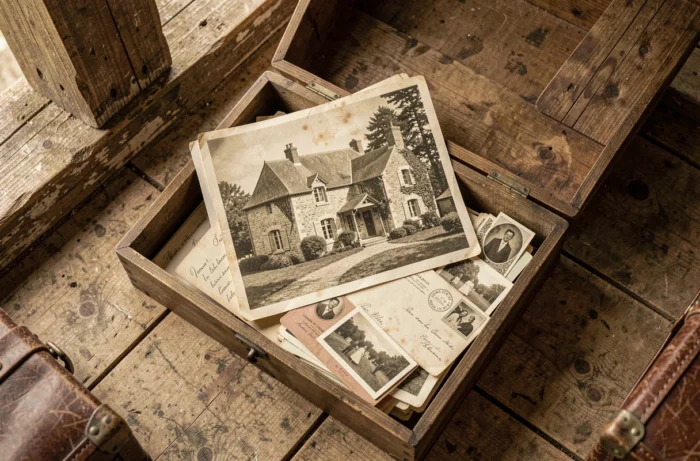
Valuing old photos of a house: beyond the digital album
Storing files in a folder does not constitute valuation. A print gains value when it is contextualized: estimated date, confirmed location, names of people present, associated event (wedding, harvest, renovations).
Several concrete avenues work well. Integrating photos into an online family tree (Geneanet offers a section dedicated to old photos) makes them accessible to other branches of the family, and sometimes to distant cousins who can identify a face. The site Portraits Anciens operates on the same collaborative principle, connecting holders of unidentified snapshots with genealogists.
For a more tangible use, one can create a printed booklet that associates each photograph with its descriptive sheet (source, cadastral location, identified owners). This format is easily shared during family gatherings and prevents the research work from being lost with a failing hard drive.
The photographic heritage of a family home is not limited to posed portraits in a studio. Shots of facades, yards, gardens, or construction sites tell the material history of a place. Cross-referencing them with cadastral and aerial sources, then archiving them in a durable format, is what transforms a handful of fragile prints into usable memory across generations.