
Buying a used car between individuals through an intermediary like CapCar requires understanding what the service actually covers and what it leaves to the buyer’s responsibility. The model has evolved: CapCar is no longer just a simple connection platform, but a structured franchise network with several hundred agents spread across the territory. This transformation changes the nature of the checks to be conducted before signing.
CapCar Franchise and Disparities Among Local Agents
CapCar was named “Best Franchise in France 2025,” a distinction that reflects the growth of the network. The milestone of 500 agents has been surpassed, each operating as an independent representative under the CapCar brand.
This structure implies a point that the official pages do not address: the quality of service varies depending on the local agent. An experienced agent who has been established for several years will not provide the same level of inspection rigor as a newly integrated agent in the network. Before reserving a vehicle, identifying the agent in charge of the transaction and checking their customer reviews is a concrete precaution.
To understand precisely how CapCar operates to verify before any signature, it is necessary to distinguish what falls under the standardized control by the brand and what depends on the professionalism of the appointed agent.

Actual Costs and Cancellation Clause: What the Displayed Price Doesn’t Say
The economic model of CapCar is based on a commission charged during the transaction. Vehicles are advertised at an average price significantly lower than in traditional commerce. This apparent saving deserves to be compared with additional costs.
| Item | Included in the displayed price | Charged to the buyer |
|---|---|---|
| Vehicle price | Yes | – |
| CapCar commission | Included in the price | – |
| Reservation fees | No | Yes (non-refundable under conditions) |
| Registration fee | No | Yes |
| Extended mechanical warranty | No (optional) | Variable depending on the plan |
| Transport/delivery | No | Yes if outside the agent’s area |
The most common point of friction concerns the cancellation clause after reservation. Recent external analyses highlight that the withdrawal conditions are sometimes poorly understood by buyers. Reservation fees may not be refunded if the cancellation occurs outside the stipulated framework. Reading the general conditions before confirming the online reservation avoids this type of disillusionment.
Technical Control and CapCar Inspection: Two Distinct Examinations
CapCar emphasizes its proprietary inspection carried out by an agent before the vehicle is put up for sale. This inspection covers a number of mechanical and aesthetic points. However, it does not replace the mandatory technical control, which remains compulsory for any vehicle over four years old.
The CapCar inspection and the technical control do not check the same elements. The technical control is standardized by the State and focuses on safety and emissions. The CapCar inspection is a commercial diagnosis: it assesses the general condition to reassure the buyer, but its scope depends on the agent conducting it.
- Ensure that the technical control is less than six months old at the time of sale, as required by regulations
- Request the detailed CapCar inspection report, not just the summary online on the vehicle sheet
- Compare the two documents: a minor defect noted in the technical control but absent from the CapCar report indicates a lack of rigor
- If the agent refuses to provide the complete report before the visit, consider this a warning sign
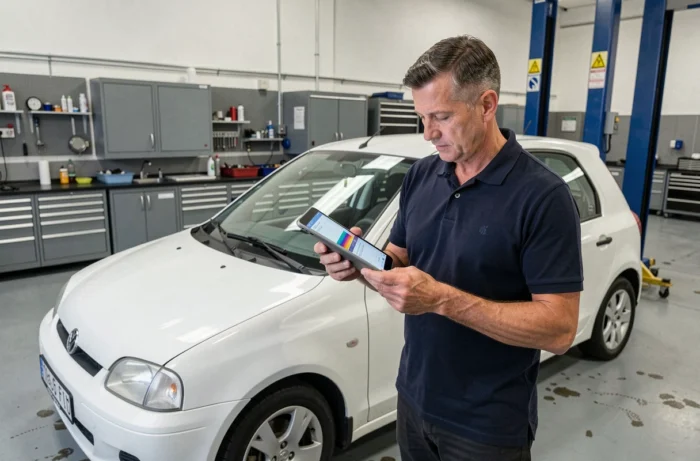
CapCar Used Car Warranty: Scope and Exclusions to Read
Vehicles sold through CapCar benefit from a mechanical warranty. The duration and scope vary depending on the chosen plan. What matters is the list of exclusions.
Wear parts are generally excluded from the warranty: brake pads, clutch, tires, battery. For a vehicle several years old, these items represent the primary expenses after purchase. Assessing the wear of these elements during the test drive or via the inspection report allows anticipating the actual budget for the first months.
The warranty also does not cover defects reported in the inspection report. If a defect is mentioned as “to be monitored” in the report and the breakdown occurs after the purchase, coverage will likely be denied. Any defect listed in the report constitutes a risk assumed by the buyer.
Check the Actual Condition Before the Test Drive
The test drive remains the only step where the buyer can personally assess the mechanical condition. Testing the vehicle cold, listening to the engine at startup, checking the steering and braking on different types of roads: these reflexes do not depend on any intermediary.
A complete maintenance history with invoices stamped by a professional remains the best indicator of reliability. If the maintenance log is blank or the seller cannot provide any invoices, caution is warranted, regardless of the results of the CapCar inspection.
The CapCar model secures part of the transaction between individuals, particularly the payment and connection. The technical and administrative checks, however, remain largely the buyer’s responsibility. Cross-referencing the inspection report, technical control, maintenance history, and one’s own observations during the test drive is the only reliable method to avoid unpleasant surprises on a used vehicle.