The trends in interior and exterior design for 2026 are not limited to a color of the year or a dominant style. Several signals converge: search data from specialized platforms, surveys of professional designers, and European regulatory developments outline a landscape that is more fragmented than it appears.
Between the return of warm neutrals, the rise of micro-retreat spaces, and the arrival of the digital product passport for construction materials, the sector is undergoing a period of restructuring at multiple levels.
Digital Product Passport: What European Regulation Changes for Design
One topic remains largely absent from the usual trend reviews: the impact of the European regulatory framework on the materials available for design projects. The Digital Product Passport, whose registry is now operational at the European Union level, imposes complete traceability of construction materials.
This system, linked to the European regulation on construction products (CPR) and the ESPR regulation on ecodesign, requires manufacturers to document the composition, origin, and recyclability of each product. For interior designers and decorators, this means gradual access to standardized technical data sheets, but also increased pressure on suppliers of non-compliant materials.
Field feedback varies on this point: some professionals see it as a lever to select more reliable materials, while others anticipate a temporary reduction in supply, particularly for products imported from outside the EU. Finding all the news on Inside Out allows you to follow these regulatory developments as they are implemented.
Warm Neutrals and Saturated Palettes: Search Data Confirms a Shift
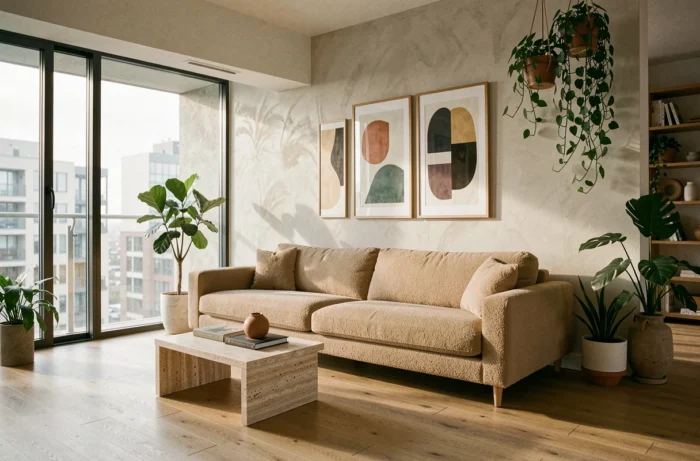
Analyses based on search data from Houzz and the Interior Designer Trends Survey from 1stDibs, published in early 2026, document a clear movement. Cool grays are declining in favor of chocolate browns, taupes, and camels. This shift is not limited to walls: it affects furniture, textiles, and flooring.
At the same time, saturated palettes are on the rise. Burgundy and cornflower blue regularly appear in the specifications of surveyed designers. The red and blue duo, already noted by several specialized publications, fits into this dynamic of bolder colors.
Maximalism and Eclecticism on a Measured Rise
The same surveys indicate a notable increase in maximalist and eclectic aesthetics for 2026. However, the phenomenon remains difficult to quantify precisely: the available data does not allow for a conclusion on whether this is a fundamental trend or a spike in interest related to social media.
What emerges more clearly is the coexistence of two seemingly opposing movements. On one side, the pure minimalist style (driven by the Pantone Color of the Year 2026, Cloud Dancer, a bright white). On the other, interiors rich in textures, patterns, and vibrant colors. Designers seem to navigate between these two poles depending on the type of project and client demand.
Micro-Retreat Spaces and Well-Being-Oriented Residential Design
Data from real estate platforms and renovation studies from 2025-2026 reveal a concrete phenomenon: the significant increase in mentions of reading nooks, wellness rooms, and “spa” bathrooms in residential projects. This trend goes beyond mere decorative anecdote.
It reflects an evolution in expectations: housing is no longer just a living space but an environment designed to absorb stress. Interior architects are now integrating these micro-spaces from the design phase, rather than as a cosmetic addition at the end of the project.
- Closed or semi-closed reading nooks, with dedicated lighting and partial sound insulation, are gradually replacing open libraries in living areas
- Bathrooms incorporate natural materials (stone, treated wood, artisanal tiles) and circadian lighting systems to replicate a spa environment
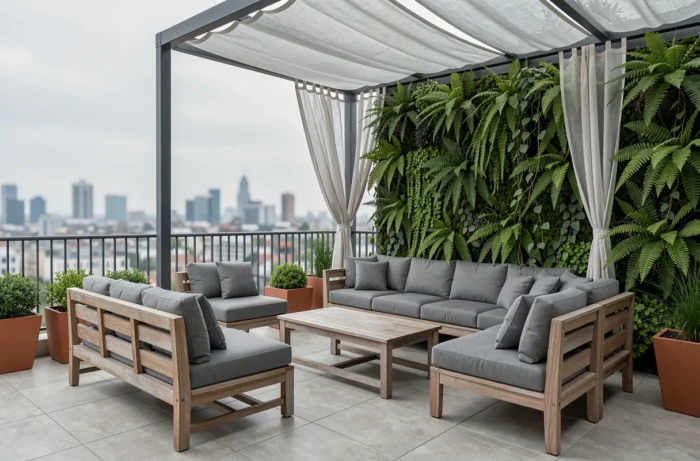
- Private outdoor spaces (balconies, terraces, patios) are reimagined as extensions of the living room, with furniture designed to withstand the elements without sacrificing comfort
Resilience Design: A Still Underrepresented Angle in France
Beyond well-being, North American data shows a rise in resilience-related features in residential design: flood protection, “zero-energy ready” homes, integration of home batteries. This aspect remains marginal in French projects, but professionals working in areas exposed to climate risks are beginning to incorporate it into their specifications.
Natural Textures and Recycled Materials: Between Discourse and Supply Reality
The use of natural and recycled materials appears in almost all trend reports for 2026. Stone, raw wood, linen, wool, artisanal ceramics: the vocabulary is well established. The question that arises concerns the actual availability of these materials at prices compatible with current projects.
Industry professionals report tensions on certain supplies, particularly for artisanal ceramics and certified woods. The European regulation on ecodesign could exacerbate this pressure in the short term by imposing traceability standards that not all suppliers are yet able to meet.
- Handmade terracotta tiles are experiencing extended delivery times in several European countries
- Textiles made from recycled fibers are gaining perceived quality, but their production cost remains higher than that of virgin fibers
- Reclaimed wood, valued for its authenticity, raises standardization questions that the digital product passport could help address
The interior and exterior design of 2026 is characterized less by a single direction than by a layering of constraints: regulatory, climatic, aesthetic. Designers’ choices reflect this complexity. The most coherent projects are those that balance these constraints rather than piling them up. The next step, for professionals as well as individuals, is to distinguish sustainable trends from fashion effects fueled by recommendation algorithms.