
A “discovery” driving course and a certified advanced training program do not require the same skills or funding circuits. Confusing the two means choosing a course that is unsuitable for your progression and paying full price when a program could have covered part of the cost. Here are the technical criteria and financial levers that public offers often overlook.
RNCP Certification and CPF Eligibility: The Filter No One Checks Before Booking
The majority of driving courses on track are leisure activities. They do not lead to any certification registered with France Compétences. The CPF only funds training that leads to an RNCP or RS certification, provided by an organization holding the Qualiopi certification, with a detailed program and formal evaluation.
In practical terms, a one-day GT course where you complete a few timed laps does not meet any of these criteria. For a driving improvement course to be eligible for the Personal Training Account, it must be listed in the Mon Compte Formation catalog, structured like a professional training program, and concluded with an evaluation test.
We recommend checking three points before any registration: the RNCP or RS registration number of the targeted certification, the actual presence of the training on Mon Compte Formation, and the Qualiopi label of the organization. Without these three elements, CPF funding is excluded, regardless of the commercial pitch.
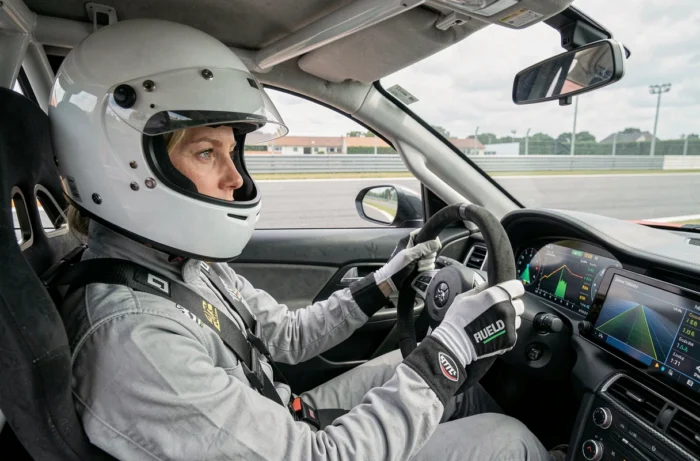
Track Driving Course: Technical Criteria for Real Progress
An amateur driver looking to advance is not seeking the same experience as a beginner looking for thrills. The choice of vehicle matters less than the quality of supervision and the educational format. Switching from a Lamborghini to a Porsche does not change your driving if the instructor merely follows you as a silent passenger.
To assess the relevance of an offer, we systematically observe these parameters:
- The instructor/student ratio: one instructor for a single driver allows for real-time debriefing, turn by turn. Beyond two students per instructor, the educational feedback becomes generic.
- The use of onboard telemetry: serious training provides data acquisition (sector lap times, cornering speeds, braking points). Without data, the debriefing relies on subjective impressions.
- The progression of the program: a structured course starts with working on progressive braking and eye placement, then moves on to weight transfer and attack trajectories. A leisure course throws you directly onto the track after a safety briefing.
- The type of vehicle relative to your goal: a single-seater or prototype exposes aerodynamic constraints absent in a GT. If your goal is competition in endurance or rally, driving a road supercar has little educational value.
A high price does not guarantee anything. The presence of telemetry and a one-to-one ratio are the two markers of a progression-oriented training. Everything else falls under experiential marketing.
Comparing prices and educational content also involves consulting a complete service on vitesseetliberte.fr on Légendes du Sport, which details the price tiers according to the targeted level.
Driving Course Funding: Alternatives to CPF for Amateur Drivers
Since most track courses remain outside the CPF perimeter, other avenues deserve exploration. OPCOs can fund driving improvement if the employer justifies a link to professional activity (transport, automotive testing, logistics professions). The request goes through the company’s skills development plan.
For job seekers, the Individual Training Aid (AIF) from France Travail can cover all or part of a certified driving training, provided it fits into a professional project validated by an advisor. The course must again be certifying and provided by a referenced organization.
Outside the professional framework, options are limited to self-funding or sports sponsorship. Some automotive sports federations offer assistance to licensed competitors in the form of scholarships or discounts on registration fees for federal events. Inquire with your regional ASA (Automobile Sports Association).

Track Layout and Driving Conditions: What Changes Your Learning
A technical circuit with slow sequences teaches more than a fast layout with large curves. Tight turns require working on heavy braking, cornering, and acceleration, three fundamentals of competitive driving. A highway layout flatters the clock but corrects no flaws.
The surface and run-off areas also matter. A circuit approved by FFSA or FIA imposes safety standards (gravel traps, SAFER barriers, run-off areas) that allow pushing limits without disproportionate risk. A repurposed karting track or an old airfield does not offer the same margins.
We recommend prioritizing weekday sessions. The number of cars on track is reduced, the actual driving time per driver increases, and the instructor can devote more attention to each participant. Weekend slots, often saturated, dilute educational quality.
Competition License and Circuit Insurance: The Hidden Costs of Progression
Moving up a level often involves aiming for an FFSA competition license. This license requires a specific medical examination, first aid training, and participation in a detection day. These costs add to the price of the course itself.
The standard insurance for a leisure course generally does not cover vehicle damage in the event of going off track. Deductibles can reach significant amounts. Before signing, ask for the exact amount of the collision deductible and check if complementary “circuit mechanical damage” insurance is offered.
The actual budget for a season of improvement thus includes training, the license, complementary insurance, and any travel expenses. Anticipating these items avoids unpleasant surprises and allows focusing the investment on courses that truly enhance your driving skills.