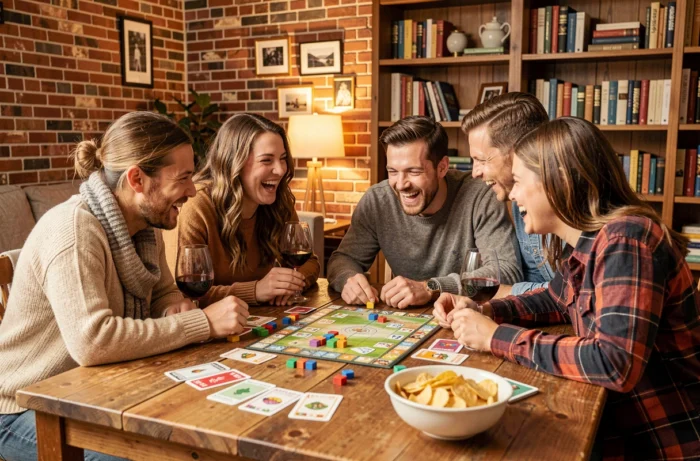
On a a Saturday night, eight people around a table, and the same Uno that has been sitting in the drawer for three years. We all know that moment when the routine sets in and game nights lose their spark. The problem doesn’t come from the group, but from the format: the same mechanics, the same rhythms, the same reflexes. To spice up your game nights, you need to change the structure of the evening itself, not just the title on the box.
Party games to social deduction: the format that revives a tired table
When you feel the energy drop after the meal, fast-paced games or trivia don’t always suffice. What works is creating tension between players, not against the game. The mechanics of social deduction (hidden roles, bluffing, secret alliances) transform a passive table into a hyperactive group.
The principle is simple: each player receives a secret role, and no one really knows who is on their side. Games rarely last more than twenty minutes, the rules can be explained in three sentences, and the game relies on speech, glances, and hesitations. You don’t need a complex board or an hour of setup.
This format has gained increasing prominence in publishers’ catalogs in recent years. You can find a variety of references on the La Minute De Jeu website to compare recent titles and identify those that fit the size of your group. The first criterion to check: the minimum number of players for the mechanics to work. Below five, most social deduction games lose their appeal.
Game nights for adults: why the audience has changed
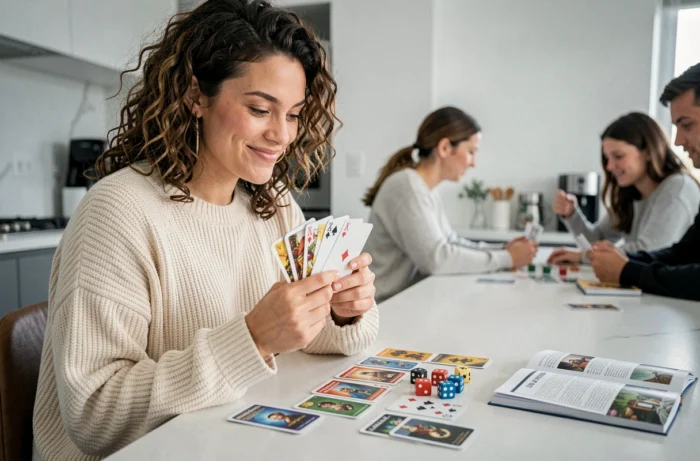
Competitors list titles but miss a market shift. The “kidult” trend is restructuring the offering: publishers are now designing games aimed at an adult audience, with more pronounced themes, polished graphic design, and mechanics that reward replayability rather than pure luck.
In practical terms, this means that board games for a night among friends are no longer limited to quizzes or charades. There are short formats with real strategic choices, card games with strong visual identities, and hybrid experiences that mix physical components and smartphone applications.
Criteria for choosing an adult party game
- The duration of a game should remain under thirty minutes to keep the group’s attention. Beyond that, side conversations take over and the game becomes background noise.
- The rules should be explained in under two minutes. If you have to reread the rulebook between each turn, the energy drops.
- A good party game provokes loud reactions, not silent calculations. Favor mechanics that generate accusations, laughter, or debates.
- Check compatibility with your number of players. A game marked “3 to 6” rarely works as well with three as it does with six.
Compact card games: the format that adapts to all parties
Compact card games are often underestimated. Their on-the-ground advantage is decisive: they fit in a pocket, can be placed on any surface (coffee table, picnic blanket, bar counter), and require no logistics. For an impromptu evening, it’s the king format.
Feedback varies on this point, but quick elimination card games seem particularly effective for mixed groups (regular players and novices). The principle: each round eliminates one player or redistributes alliances, which keeps even spectators engaged.
Three situations where the compact card game saves the evening
First case: the prolonged aperitif. Pulling out a card game at this precise moment refocuses the group’s energy without formalizing the evening. No need to clear the table or set anything up.
Second case: the group is too large. When there are more than eight of us, most classic board games can’t keep up. Some card games accommodate ten players or more, with simultaneous turns that avoid waiting.
Third case: the end of the evening. After two hours of heavier games, a format of five minutes per game revives those who were starting to lose interest. A good end-of-evening game is played standing up, with no explanation, and provokes laughter from the very first round.
Atmosphere and alcohol: organizing without slipping
You can’t talk about game nights among adults without addressing the issue of alcohol. Many “drinking games” circulate online, but most rely on punitive mechanics (the loser drinks) that kill the pace and pose a real dosage problem.
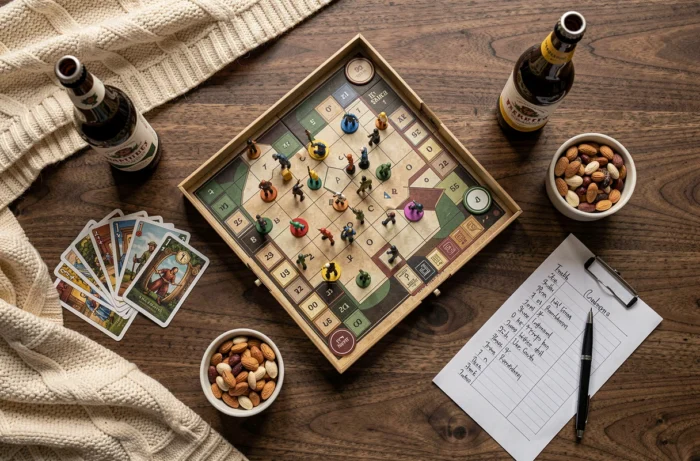
The approach that works best: integrate drinks as a social element, not as a game stake. Set up a cocktail bar or a selection of beers, and the game runs alongside. Players drink at their own pace, not at the pace of penalties. The result: the evening lasts longer, no one drops out after an hour, and the game remains playable.
For groups that still want a link between game and drink, a simple variant: the winner of each round chooses the next cocktail that everyone tastes. The stake becomes positive, not punitive.
Party and birthday: adapting the format to the number of guests
During a birthday or a party with more than twelve people, a single game around a table no longer works. The on-the-ground solution: create two or three game stations in different spaces, with varied formats (a quick card game, a noisy party game, a quiz corner). Guests circulate freely between the stations.
This system solves the classic problem of game nights in large groups: no one waits more than two minutes for their turn. Each station accommodates four to eight players, games turn quickly, and groups mix naturally throughout the evening.
The last point not to be overlooked: background music. A volume that’s too high makes communication games impossible. A light background sound, on the other hand, fills the silences between rounds and maintains a party energy without drowning out voices. Set the volume so that a normal conversation is possible one meter from the speaker, and leave it alone.