
The gluten-free product market continues to grow, driven by a demand that far exceeds the circle of diagnosed celiac individuals. At the same time, European regulations on allergen labeling are tightening, with concrete changes expected by the end of 2027. Between regulatory developments, persistent cost increases, and new supply chains, everyday gluten-free eating is undergoing a transformation that deserves a precise assessment.
Allergen labeling and gluten threshold: what the new rules change
The Codex Alimentarius has introduced a reference dose of 4 mg of gluten to assess the risks of cross-contamination. This value now serves manufacturers to determine whether a precautionary statement such as “may contain wheat” should appear on the packaging of a standard product. It does not replace the regulatory threshold of 20 ppm that defines a “gluten-free” product, but it structures the risk analysis upstream.
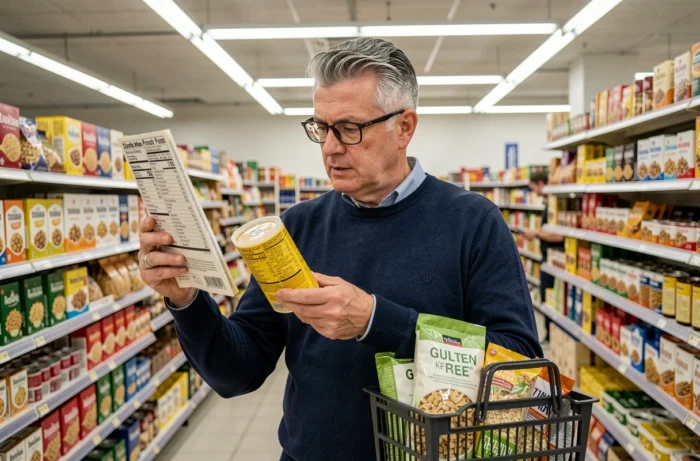
A more visible change for consumers: it becomes forbidden to display both “gluten-free” and a precautionary statement for gluten on the same product. In practice, a packet of cookies can no longer bear both the “gluten-free” logo and the statement “may contain traces of wheat.” This clarification should reduce the confusion that has prevailed on the shelves, where some packaging has previously sent contradictory signals.
The European Commission plans to integrate these principles into a harmonized implementing regulation on allergen labeling, scheduled for the fourth quarter of 2027. Manufacturers therefore have a compliance deadline, but the most responsive brands are already adapting their packaging. To keep up with these regulatory developments, the information from the Gourmand Sans Gluten website helps stay updated on industry news.
Cost of a gluten-free diet: a documented but rarely quantified barrier
The price remains the major point of friction for individuals following a strict gluten-free diet. This additional cost represents several hundred euros more per year compared to a standard diet. This differential particularly weighs on low-income households and families with several affected members.
Several factors explain this price gap:
- Alternative raw materials (rice flour, cassava starch, buckwheat flour) are more expensive to produce and source than standard wheat flour.
- Dedicated production lines, necessary to avoid cross-contamination, involve additional investments that are passed on to the final price.
- The sales volume of gluten-free products remains lower than that of conventional equivalents, limiting economies of scale.
Public assistance varies from one European country to another. In France, coverage by Health Insurance only applies to diagnosed celiac individuals, with a monthly cap that covers only a fraction of actual expenses. Non-celiac gluten-sensitive individuals do not receive any assistance.
Alternative flours and emerging supply chains: beyond rice and corn
The offer of gluten-free flours has long been limited to rice and corn. These two cereals still dominate the shelves, but new supply chains are gaining ground and gradually changing the composition of available products.
Fonio, a West African cereal naturally free of gluten, is among the rising ingredients. Its nutritional profile (rich in sulfur-containing amino acids, low glycemic index) distinguishes it from white rice, often criticized for its lack of micronutrients. French brands are now incorporating it into ranges of pasta and ready-to-use flours.
Organic rice flour is also experiencing its own dynamic, driven by the combined demand for gluten-free and organic products. The organic rice flour market is growing at a steady pace, with diversification towards more nutritionally interesting whole or semi-whole varieties.
Nutritional balance and gut microbiota
A strict gluten-free diet exposes individuals to certain deficiencies if substitutions are not well thought out. Gluten-free industrial products often contain more sugars, fats, and additives than their gluten-containing counterparts, to compensate for the loss of texture due to the absence of this protein.
Recent studies explore the link between a gluten-free diet and gut microbiota. The hypothesis being studied: acting on the gut flora could compensate for certain nutritional deficiencies induced by the exclusion of gluten. This avenue remains exploratory, but it fuels an active research field in gastroenterology.

Cross-contamination in restaurants: a persistent blind spot
Eating gluten-free at home is one thing. Eating in a restaurant is another. French regulations require restaurateurs to inform their customers about the presence of the 14 major allergens, gluten included. In practice, feedback from the field varies on this point: staff training remains uneven, and protocols to avoid cross-contamination vary significantly from one establishment to another.
The most common sources of contamination in restaurants:
- Shared frying oil between breaded products (containing wheat) and foods supposed to be gluten-free.
- Non-dedicated cutting boards and utensils, where flour residues persist despite cleaning.
- Industrial sauces and seasonings used in the kitchen, whose composition is not always verified by the staff.
For celiac individuals, even minimal contamination can trigger an intestinal inflammatory reaction. Caution requires asking specific questions about preparation methods, without relying solely on the “gluten-free” label on the menu.
Gluten-free eating is gaining visibility and available options, but concrete challenges persist. The annual additional cost remains significant, labeling will be clarified by 2027 without resolving all ambiguities, and vigilance against cross-contamination remains a daily constraint.